
When a 16-year-old forward leaves home to play juniors, the talent that got him there is only half the equation. The other half is what happens off the ice.
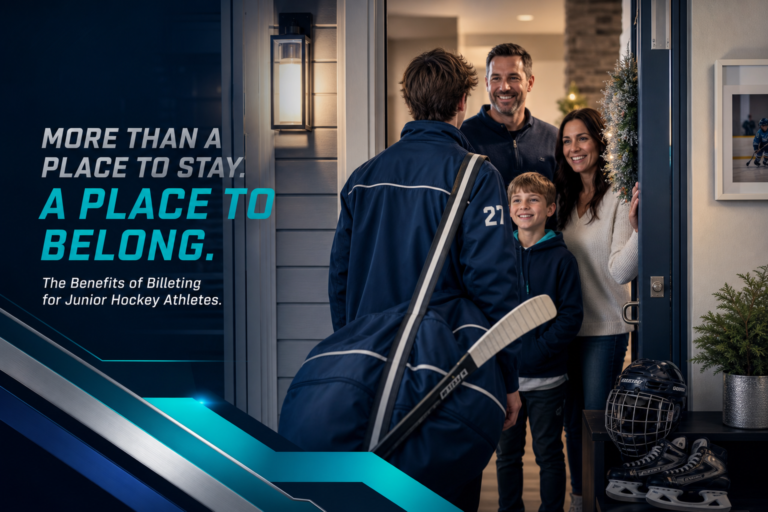
Billeting is often discussed as a logistics problem: the team needs housing, a family has a spare room, and someone has to make the paperwork work. That framing misses the point entirely.
For players, billeting is one of the most powerful development tools in the sport. Not because of the room itself, but because of the environment that surrounds it.
Here’s why that matters more than most families realize.
1. Structure Breeds Performance
A billet home is not a hotel. It’s a functioning household with expectations, routines, and accountability.
Players who billet with engaged families eat better, sleep on schedule, and come home to a space that reinforces discipline rather than pulling against it. Research in adolescent development consistently shows that structured environments improve academic performance, reduce risky behavior, and strengthen executive function. For an athlete trying to manage school, training, and competition, that structure isn’t a luxury. It’s infrastructure.
The best billet families don’t hover. They provide a framework. Meals happen at reasonable times. Curfews exist. Laundry gets done. These small consistencies compound over a season into a foundation that lets athletes focus their energy where it belongs: on getting better.
2. The Commute Calculation
This one is simple math, but the impact is real.
A player driving 45 minutes each way to the rink, school, and workouts burns 90 minutes a day. Over a season, that’s more than 300 hours lost to windshield time. Hours that could have gone to extra ice work, film study, sleep, or recovery.
Billeting places athletes minutes from their rink, school, and training facility. The reduced commute doesn’t just save time. It eliminates a daily drain on mental energy that most players absorb without recognizing how much it costs them.
When you cut the commute, you don’t just get hours back. You get focus back.
3. Community Becomes Competitive Advantage
A player who lives in the town where he plays experiences it differently than one who commutes through.
He knows the local restaurants. He recognizes faces at the grocery store. He develops relationships with billet family friends, coworkers, and neighbors who become part of his world. This exposure builds social skills, cultural awareness, and the kind of comfort in unfamiliar environments that scouts notice.
Hockey careers move players across cities, provinces, and countries. The player who has already practiced adapting to a new community has a significant head start. Billeting is the first real rehearsal for the professional life ahead.
4. A Support System That Scales
Parents cannot be everywhere. Coaches cannot be everything.
A billet family fills a gap that no roster spot or training program can address: daily, on-the-ground emotional support. A billet mom who notices a player seems off after a tough game. A billet dad who asks the right questions without prying. A household where a teenager feels safe enough to struggle without performing strength he hasn’t built yet.
This built-in support network is one of the most underappreciated benefits of billeting. Players who feel supported off the ice consistently perform better on it. The research on this is unambiguous. Athletes with strong social support systems demonstrate higher resilience, lower anxiety, and greater long-term retention in their sport.
For families considering billeting their own child, this is often the factor that tips the decision. Not the hockey. The safety net.
5. The Financial Reality
Hockey is expensive. Every family knows this.\n
Billeting reduces costs in ways that are both obvious and overlooked. The obvious: no long-distance commute means lower fuel costs, reduced vehicle maintenance, and less wear on a family’s budget.
The overlooked: billet families typically provide meals, Wi-Fi, and basic household needs. For a player’s parents, this can mean the difference between affording the season and stretching beyond what’s sustainable. For teams, offering quality billet arrangements is one of the most effective tools for attracting players who might otherwise choose a closer, less expensive option.
Cost savings aren’t the reason to billet. But they remove a barrier that keeps talented players from pursuing the level they belong at.
6. The Life Skills That Matter After Hockey
Every hockey career ends. The question is what the player carries with him when it does.
Billeting teaches skills that no practice plan covers. Living with a family that isn’t yours requires communication, compromise, and emotional intelligence. Navigating a new household builds adaptability. Managing a relationship with billet parents while maintaining independence develops exactly the kind of maturity that employers, coaches, and future partners value.
Players who billet learn to introduce themselves, manage conflict gracefully, express gratitude, and operate within a community they didn’t grow up in. These aren’t soft skills. They are the skills that determine how far someone goes in life, in hockey, and in everything between.
The billet experience is, in many ways, a compressed version of what adult life demands. And it arrives at the exact age when those lessons have the most impact.
Why the Match Matters
Everything described above depends on one thing: the right fit.
A poor billet match doesn’t just fail to deliver these benefits. It actively undermines them. A player placed in a household with incompatible expectations, poor communication, or minimal engagement won’t develop faster. He’ll develop resentment.
This is why BilletMatch exists.
BilletMatch is the platform that connects athletes with billet families based on compatibility, not convenience. It gives teams the tools to manage, monitor, and optimize their housing programs. It gives families confidence that their home is the right fit. And it gives players the foundation they need to perform at their highest level.
The billet advantage is real. But it only works when the match is right.
BilletMatch makes sure it is.
Learn more at BilletMatch.com.

Leave a Reply