
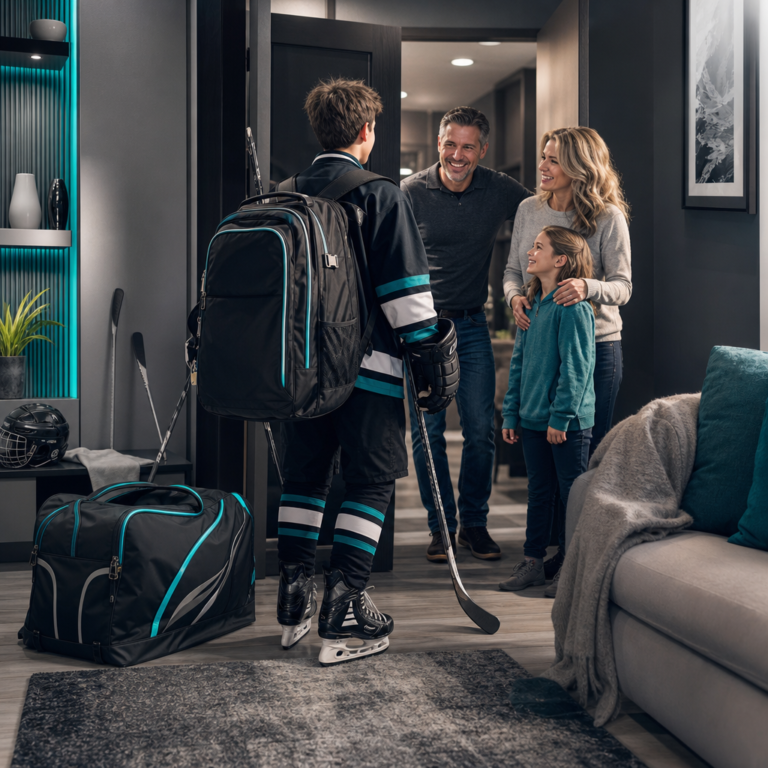
Every young athlete deserves more than just a place to sleep.
They deserve a place where they can study after practice, feel safe when the season gets tough, and have someone asking about their game when they walk through the door. In junior hockey, that place is called a billet home. And whether you run a team, host a player, or send your child across the country to chase a dream, the quality of that arrangement shapes everything.
Sports billeting is one of the most important, least understood parts of junior hockey. Get it right, and you build a foundation for player development, community loyalty, and seasons that players remember forever. Get it wrong, and you are dealing with no-shows, mid-season moves, frustrated families, and a coaching staff spending more time on housing logistics than game strategy.
If you have ever managed a billet program with spreadsheets, group texts, and a prayer, this guide is for you.
Why Billeting Matters More Than Ever
Junior hockey is growing. The number of teams competing for players keeps expanding, and families have more options than ever before. A player choosing between two programs will factor in the billet experience as heavily as ice time and coaching.
For organizations, billet program management is no longer a back-office task. It is a recruiting tool, a retention strategy, and a safeguard for your athletes’ well-being. Teams that treat athlete housing as a core function, rather than an afterthought, attract better talent and keep it longer.
The math is simple: if a 17-year-old is unhappy at their billet home, they are not finishing the season with your team. And when word gets around that your organization does not take billeting seriously, other families notice.
The Problem: How Most Teams Still Manage Housing
Here is what billeting looks like for many junior hockey organizations in 2026.
A volunteer coordinator maintains a spreadsheet with host family addresses, player names, and phone numbers. A Facebook group is used to match families with incoming players. The coordinator texts back and forth with parents trying to confirm pickup times, dietary restrictions, and sleeping arrangements. When a conflict arises, like a player and host family that are not a good fit, everyone scrambles.
This approach creates several real problems.
Information scattered everywhere. Critical details about housing arrangements live in text messages, email threads, and handwritten notes. When the coordinator changes, institutional knowledge disappears overnight.
Matching based on convenience, not compatibility. Without a structured process, teams pair players with whoever volunteers first, regardless of whether the arrangement actually works for both sides.
No visibility for team leadership. General managers and coaches often have no real-time view of which players are housed, how those arrangements are going, or whether any families are at risk of dropping out mid-season.
Liability concerns. Junior hockey players are minors in most leagues. Teams that cannot demonstrate a vetted, documented housing process are exposed to significant risk.
The spreadsheet worked fine when a team had 12 billet families and 15 players. It does not work when your organization is scaling, when you are managing rosters across multiple levels, or when parents expect the same professional experience they get from every other part of the program.
The Solution: A Platform Built for Billet Program Management
This is exactly why we built BilletMatch.
BilletMatch is a dedicated platform for sports teams to attract, match, monitor, and manage housing for their athletes. It replaces the scattered, manual process with a centralized system designed specifically for the unique dynamics of billeting.
Here is what that looks like in practice.
Structured matching. Instead of guessing, teams can create detailed profiles for both players and host families. BilletMatch helps identify compatible matches based on location preferences, family composition, pet considerations, transportation needs, and other factors that actually matter.
Centralized communication. No more digging through text threads. BilletMatch gives teams, families, and players a single place to coordinate, share updates, and resolve issues before they become problems.
Real-time monitoring. Team administrators can see the status of every housing arrangement at a glance. Which players are placed? Which families are active? Are there any relationships that need attention? That visibility transforms billet program management from reactive to proactive.
Scalable team housing solutions. Whether you are running a single midget team or managing housing across an entire junior hockey organization, BilletMatch scales with you. The platform handles the complexity so your staff can focus on hockey.
We built this under the Dump & Thump Sports ecosystem because we have lived the problem. We have watched teams struggle with the same broken processes year after year, and we knew there had to be a better way to connect hockey players with billet families.
The Deeper Value: What Great Billet Families Actually Provide
Let us talk about something that gets lost when we focus on logistics.
A billet family does not just provide a bed and three meals a day. The best billet families provide something that a program cannot buy at any price: a home.
They are the ones who drive a 16-year-old to morning skates. They celebrate goals and sit with players after tough losses. They make sure homework gets done, teach a young athlete how to do laundry, and become part of a family that did not exist six months ago.
The research on junior hockey athlete development consistently points to off-ice environment as a major factor in on-ice performance. Players who feel supported, stable, and connected perform better. Players who feel like a guest in a stranger’s house, or worse, like an inconvenience, often do not finish the season.
This is why the billeting relationship matters so much. And this is why the way teams manage that relationship matters just as much.
When you take billet program management seriously, you are not just filling rooms. You are building a network of families who become ambassadors for your organization. You are creating an environment where players develop as people, not just athletes. And you are giving parents the confidence that their child is in good hands when they are hundreds of miles from home.
That is the real promise of great athlete housing. It is not a logistics problem to solve. It is a relationship to nurture.
How to Get Started
If your team is still managing billets the old way, here is what we recommend.
Audit your current process. How many hours per week does someone spend on housing logistics? Where does information live? What happens when something goes wrong?
Talk to your families. Both host families and player parents. Ask them what works, what does not, and what they wish was different. You will hear consistent themes.
Look for a purpose-built solution. General tools can get you partway there. A platform designed specifically for sports billeting, like BilletMatch, gets you all the way.
Start small and build. You do not have to overhaul everything at once. Begin with one team or one age group, prove the model, and expand from there.
Ready to Transform Your Billet Program?
BilletMatch is designed for teams that are ready to stop managing housing with workarounds and start building a billet program that supports player development, impresses families, and scales with your organization.
Start your free trial at billetmatch.com and see how much easier sports billeting can be when you have the right platform behind it.
Know a team that is still stuck in the spreadsheet era? Share this guide with them. And if you have a billeting story, good or bad, drop it in the comments. We want to hear what is working and what is not.
Because every athlete deserves a place to belong. Let us make sure they get one.


Leave a Reply